The most luxurious, densely woven silk in your stash is often the very reason your nuno felting turns stiff as cardboard. You have likely spent hours gently rolling and fulling, only to find stubborn wool fibres sitting flat on the surface, refusing to entangle. It is a disheartening feeling, especially when you envisioned a fluid, gossamer textile. Choosing the best silk for nuno felting is never about finding the heaviest fabric; it is about honouring the delicate dialogue between fibre migration and weave openness.
When you understand how structure governs movement, frustration gives way to pure creative freedom. You will discover which silk weaves and momme weights allow effortless wool migration, ensuring your finished pieces drape like liquid rather than setting like felted armour. From airy open weaves to crisp organza and smooth habotai, we will guide you through selecting the ideal foundations for breathtaking, puckered textures and wearable art.
Key Takeaways
- Discover how open weaves and low momme weights permit wool scales to travel freely, revealing the secret to selecting the best silk for nuno felting.
- Explore the sensory contrasts between supple Silk Habotai and crisp Silk Organza to achieve bespoke ruching, crinkles, and tactile surface relief.
- Master the balance of pairing fine Merino fleece with gossamer fabric weights, banishing board-like stiffness in favour of a fluid, liquid drape.
- Learn why genuine natural silk is vital for microscopic fibre entanglement, alongside essential steps to cleanse fabrics of factory sizing before felting.
What Makes the Best Silk for Nuno Felting? Weave, Weight, and Fibre Migration
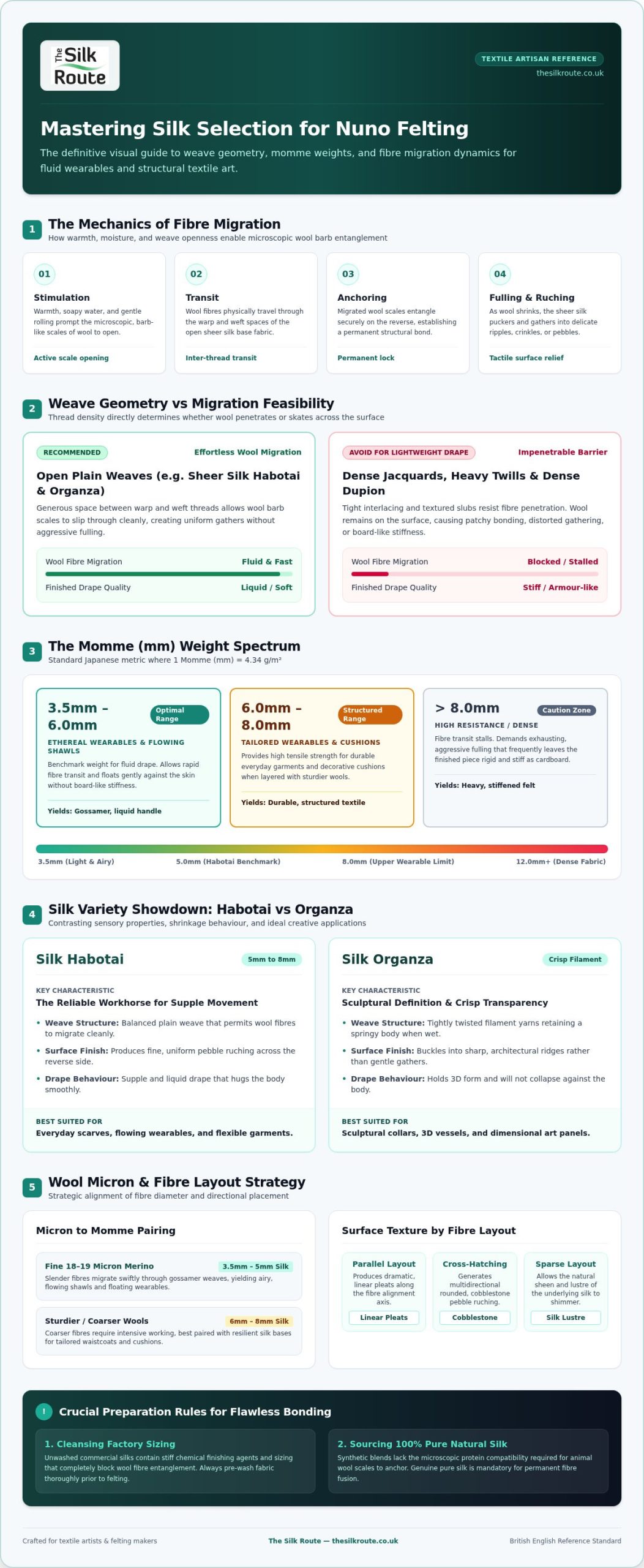
Originally developed in Japan, Nuno felting bonds loose animal fibres through a sheer textile base. Warmth, soapy water, and gentle rolling prompt the microscopic, barb-like scales of wool to open. These fibres must physically travel between the silk warp and weft threads to anchor securely. Without this migration, the wool won’t fuse; it merely skates across the surface. Unwashed commercial silks with stiff finishing agents block this entanglement completely.
The Mechanics of Fibre Migration: Why Weave Structure Matters
Weave geometry governs your textile’s tactile finish. Open plain weaves invite wool scales to slip through effortlessly, whereas dense jacquards and heavy twills present an impenetrable barricade where fibres can’t take hold. Thread spacing directly dictates how your piece puckers as the wool shrinks. An airy, consistent weave creates cascading, rippled textures. In contrast, uneven or overly tight weaves cause frustrating patchy bonding and distorted gathering.
Decoding Momme Weight: The Ideal Range Between 3.5mm and 8mm
Fabric weight directly dictates drape. Silk density is measured in momme (mm), a traditional Japanese unit where one momme equals 4.34 grams per square metre. For ethereal wearables that float against the skin, 3.5mm to 6mm is the benchmark range for the best silk for nuno felting. If you choose fabrics exceeding 8mm, fibre transit stalls, requiring aggressive, exhausting fulling that often leaves the piece stiff. Identifying the best silk for nuno felting ultimately hinges on ensuring the silk remains light enough for effortless migration.
Comparing the Top Silk Fabrics: Habotai, Organza, and Lightweight Weaves
Every weave behaves distinctly once moisture and movement take hold. Examining the physical properties of silk fabric reveals how twist, density, and filament structure dictate your final piece. Gauzy textiles bond almost instantaneously, yielding liquid drape, whereas structured weaves require measured friction. To experiment across this tactile spectrum, browsing pure natural selections at The Silk Route offers an inspiring starting point for both delicate wearables and textured wall hangings.
Silk Habotai: The Reliable Workhorse for Fluid Wearables
For makers seeking dependable, supple movement, Silk Habotai remains the gold standard. Its balanced plain weave permits wool fibres to migrate cleanly, producing fine, uniform pebble ruching across the reverse side. Ranging between 5mm and 8mm, it provides durable tensile strength for everyday scarves and garments. Unlike heavily textured fabrics like hand woven silk dupion, whose dense slubs naturally resist fibre penetration, sheer Habotai stands out as the best silk for nuno felting when effortless fluidity is your aim.
Silk Organza: Sculptural Definition and Crisp Transparency
If your project calls for structural drama, Silk Organza provides a striking contrast. Crafted from tightly twisted filament yarns, it retains a springy, transparent body even when wet. As the wool contracts, the organza buckles into sharp, architectural ridges rather than gentle gathers. It won’t collapse against the body, making it magnificent for sculptural collars, vessels, and dimensional art panels. Finding the best silk for nuno felting ultimately comes down to whether your vision demands gossamer softness or bold, defined relief.
How to Choose the Right Silk Fabric for Your Specific Felting Project
Successful textile creation begins with your intended end use. Balancing wool micron count against silk density governs how much the fabric shrinks, directly shaping the final hand. Pairing ultra-fine 18 to 19 micron Merino fleece with 3.5mm to 5mm silk yields airy, flowing shawls. Meanwhile, sturdier wools layered over 6mm to 8mm bases create durable, structured textiles for tailored waistcoats or decorative cushions.
Matching Silk Variety to Wool Micron and Fibre Layout
Slender fibres migrate swiftly through delicate silks, whereas coarser wools struggle unless they’re worked intensely. Your layout pattern also dictates surface relief. Laying wool strands parallel produces dramatic linear pleats, while cross-hatching creates rounded, cobblestone pebbles. Placing fibres sparingly lets the inherent lustre of the underlying weave shimmer through, spotlighting the best silk for nuno felting rather than burying it under heavy fleece.
Designing for Drape: Wearable Scarves versus Structured Textile Art
Choose gossamer weights when crafting pieces meant to rest directly against the neck, ensuring fluid movement without chafing. Conversely, sculptural vessels, framed tapestries, and experimental hangings benefit from crisper foundations that hold their shape. Textile artists often paint their grounds first; selecting suitable silk fabric for painting allows you to introduce vivid watercolour hues before fusing wool. Testing small swatches remains the most reliable way to pinpoint the best silk for nuno felting before committing to large-scale work.
Preparing and Sourcing Pure Silk: Essential Tips for Flawless Nuno Results
Even the finest weave fails if factory treatments coat the fibres. Genuine 100% natural silk possesses microscopic surface scales and protein affinities that welcome animal fleece. When synthetic polyester blends or chemical starches enter the mix, wool fibres simply slide off rather than locking into the yarns. Warm, soapy water and deliberate, gentle rolling encourage initial fibre migration through the weave, coaxing wool scales to entangle before vigorous fulling begins.
Pre-Washing and Degumming: Ensuring an Unobstructed Fibre Bond
Commercial silks arrive with industrial sizings and starches designed to keep the cloth crisp during transport. These coatings act as an impenetrable chemical barrier, repelling water and sealing thread gaps. Swish your fabric gently in warm water with a mild, pH-neutral soap, then rinse thoroughly and air dry. Always felt a small test swatch before cutting into precious yardage. This brief step confirms fibre adhesion and reveals your specific wool’s shrinkage rate without risk.
Sourcing Natural Silks: The Advantage of Specialist Curated Packs
Working with unfamiliar fabrics often feels daunting. Sampling versatile weaves through curated Natural Silk Packs and Silk Theme Packs gives makers a risk-free route to discover what behaves best under wet friction. Beware generic bargain fabrics; polyester disguises itself remarkably well but permanently resists natural entanglement, ruining hours of careful layout. Sourcing unadulterated fabrics from a dedicated UK specialist like The Silk Route guarantees you receive pure substrates that bond reliably. Investing in authentic materials ensures you find the best silk for nuno felting every time, turning delicate fleece into exquisite, enduring textile art.
Elevate Your Textile Art with the Perfect Silk Foundation
Achieving fluid drape and intricate ruching is within your reach once you align weave openness with your wool layout. Selecting the best silk for nuno felting always centres on unhindered fibre migration, whether you opt for the supple cascade of lightweight Habotai or the architectural crispness of Organza. Pre-washing pure fabrics ensures wool scales grip securely without chemical barriers getting in the way.
If you’re eager to experiment, curated Natural Silk Packs and Silk Theme Packs offer an ideal canvas for tactile play. As an independent UK specialist in pure natural silks, The Silk Route pairs exquisite fabrics with personalised guidance for your creative journey.
Trust your hands, embrace the alchemy of wool and water, and watch your felting flourish into wearable poetry.
Frequently Asked Questions
Can you use any silk fabric for nuno felting?
No, you cannot use just any silk fabric for nuno felting. Densely woven weaves like heavy bridal satins, stiff jacquards, or synthetic polyester blends actively repel wool fibres. For successful bonding, you need pure natural silks with open, pliable weaves. Lightweight fabrics like airy habotai, gossamer gauze, or crisp organza allow wool scales to penetrate between warp and weft threads easily, whereas dense textiles block migration.
What is the best momme weight of silk for nuno felting scarves?
The best momme weight when choosing the best silk for nuno felting scarves sits between 3.5mm and 6mm. Silks in this delicate range, such as lightweight Silk Habotai, provide sufficient tensile strength while staying gossamer-light. This allows fine Merino fibres to migrate freely without exhausting friction. Heavier fabrics above 8mm produce a rigid, board-like drape that lacks the supple fluidity essential for wearable accessories.
Why is my wool not adhering to the silk during nuno felting?
Wool fibres fail to adhere primarily due to impenetrable fabric density, synthetic blends, or factory sizings. If your silk is tightly woven, wool scales cannot slip between the threads. Similarly, chemical finishes act as a slick shield that blocks entanglement. Using wool with a high micron count or rolling too aggressively early in the process can also dislodge fibres before they anchor properly into the silk substrate.
What is the difference between silk chiffon and silk habotai in nuno felting?
Silk chiffon features a crepe-twist yarn with a loose, slightly textured open weave, whilst Silk Habotai is a classic, smooth plain weave. Chiffon’s openness lets wool penetrate rapidly, creating soft, organic puckering with minimal effort. In contrast, Habotai provides a slightly firmer surface that yields uniform, tactile pebble gathers. Both are exceptional foundations, but Habotai offers superior durability for garments requiring regular wear and structure.
Do I need to pre-wash pure silk fabric before nuno felting?
Yes, pre-washing pure silk before felting is essential for reliable fibre adhesion. Manufacturers apply chemical sizings, starches, and protective agents to keep yardage crisp during shipping, creating an invisible barrier that repels water and wool scales. Gently washing your silk in warm water with a mild, pH-neutral soap dissolves these coatings. Ensuring clean yarns helps you achieve the best silk for nuno felting results without frustrating bonding failures.