
The rhythmic clatter of a wooden loom in a quiet Indian village isn’t just a sound; it’s the heartbeat of a textile that defies industrial perfection. Many designers and enthusiasts find themselves captivated by the iridescent shimmer of hand woven silk dupion, yet they often hesitate, wondering if the characteristic “slubs” are signs of quality or merely structural flaws. If you’ve ever felt uncertain about distinguishing authentic hand-loomed silk from low-grade alternatives, or struggled to find a dependable source right here in the UK, you aren’t alone.
We understand that working with such a delicate, storied material requires both inspiration and technical clarity. This guide promises to transform your perspective on this ancient craft, offering you the knowledge to embrace its unique texture with absolute confidence. You’ll discover the rich heritage behind Indian silk production, learn the essential secrets of professional care, and see how these artisanal threads can elevate your creative vision from the ordinary to the extraordinary. From the intricacies of the weave to the practicalities of sourcing, we’ll navigate the beautiful complexities of this timeless fabric together.
Key Takeaways
- Learn to identify the hallmark “slubs” and iridescent lustre that define authentic hand woven silk dupion, distinguishing it from machine-made alternatives.
- Understand how the rhythmic variations of the hand-loom create a denser, more structural fabric ideal for high-end couture and bespoke interiors.
- Discover the “cross-colour” technique where contrasting warp and weft threads produce a shimmering, multidimensional finish.
- Gain confidence in selecting the right silk weight for projects ranging from structured bridal gowns to opulent drapes and soft furnishings.
- Connect with a specialist UK source for 100% natural Indian silk and bespoke colour-matching services tailored to your specific creative needs.
What is Hand Woven Silk Dupion?
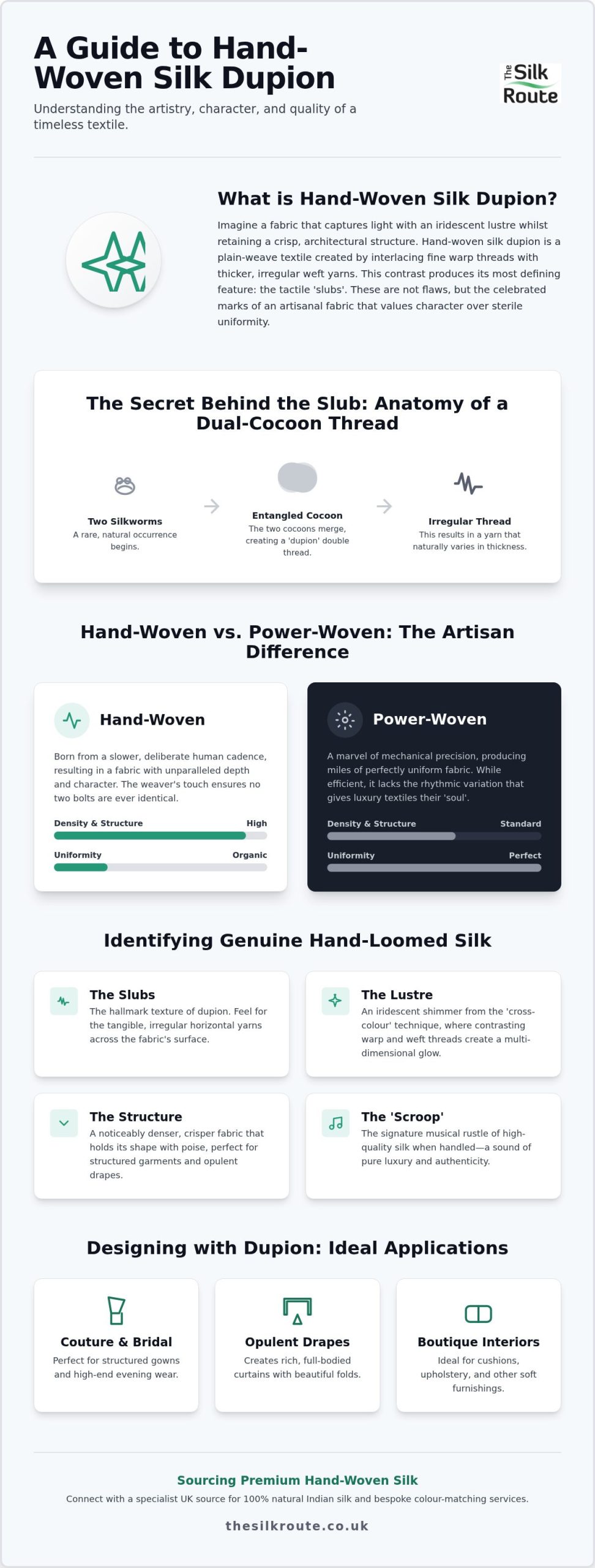
Imagine a fabric that captures the light like burnished metal whilst retaining a crisp, architectural structure that holds its shape with poise. This is Dupioni silk, specifically the artisanal variety that has graced couture houses for centuries. Hand woven silk dupion is a plain-weave textile produced by interlacing fine, consistent silk threads in the warp with thicker, irregular yarns in the weft. This deliberate contrast results in a fabric that is both ethereal and remarkably robust. It’s the tactile “slubs”, those horizontal irregularities, that give the cloth its distinctive soul. These aren’t manufacturing defects; they’re the deliberate marks of a premium tier of textile production that values character over sterile uniformity.
The sensory appeal of this silk is immediate. When you run your hand across its surface, you feel a unique combination of a crisp, almost papery handle and a deep, metallic lustre. Why does this texture matter so much to the modern creator? It’s because the fabric speaks to the senses, inviting you to explore its ridges and valleys. For the designer, it offers a structural integrity that makes it the cornerstone of bridal and evening wear. For the interior enthusiast, it provides a richness of texture that transforms a room, often serving as a perfect complement to the high-quality furniture found at Nicholas Wells Antiques. This is the enduring legacy of Indian silk heritage, where the marriage of nature and human skill creates something truly peerless.
The Origins of Indian Dupion Silk
India remains the spiritual and technical heart of this magnificent craft. Weaving centres across the subcontinent have preserved techniques that have remained largely unchanged for hundreds of years. Whilst modern technology offers speed, the traditional hand-loom remains the pinnacle of textile character. Amongst these artisan communities, weaving isn’t just a trade; it’s a cultural identity passed down through families. Each metre of hand woven silk dupion carries the subtle variations of the weaver’s touch. This human element ensures that no two bolts are ever identical, offering a level of exclusivity that mass-produced fabrics can’t hope to match.
The Anatomy of a Dual-Cocoon Thread
The secret to this fabric’s unique personality lies in a biological quirk of the silkworm. Occasionally, two silkworms spin their cocoons so closely together that the silk filaments become naturally entangled. This rare occurrence creates the “dupion” or double thread. When these double cocoons are reeled together, they produce a thread that is inherently irregular, fluctuating in diameter along its entire length. These naturally tangled and knotted fibres are what result in the characteristic thick-and-thin texture known as slubs. In a world of synthetic perfection, these slubs are a badge of luxury. They break up the reflection of light, creating a shimmering, multidimensional glow that adds depth to every fold and drape.
Hand Woven vs. Power Woven: Understanding the Artisan Difference
The industrial revolution gifted the textile world with the power loom, a marvel of mechanical precision capable of producing miles of perfectly uniform fabric. Whilst these machines are efficient, they often lack the rhythmic variation that breathes life into a luxury textile. Hand woven silk dupion is fundamentally different. It is born from a slower, more deliberate cadence. Because a human artisan controls the loom, they can apply more force to the “beating” of the weft, resulting in a fabric that is noticeably denser and more substantial than its power-woven counterpart. This density isn’t just about weight; it’s about the visual depth created by the subtle, organic shifts in the weave pattern that no machine can truly replicate.
Sustainability is woven into the very fabric of hand-looming. By choosing these artisanal methods, you’re supporting the preservation of heritage skills that have defined the history of the silk trade for millennia. These looms require no electricity, relying instead on the weaver’s physical strength and expert eye. This low-impact production method creates a connection between the creator and the source, ensuring that every metre of silk tells a story of human skill rather than mechanical repetition.
Why the Human Touch Matters in Weaving
A weaver doesn’t just operate a machine; they engage in a sensory dialogue with the silk. By manually adjusting the tension of the warp, the artisan creates a cloth with “soul”, a quality that manifests in the way the fabric moves and sounds. Have you ever noticed the “scroop” of high-quality silk? It’s that distinctive, musical rustle that occurs when the fibres rub together. In hand-loomed batches, this sound is often deeper and more resonant. These small-scale productions offer an exclusivity that mass-produced rolls simply cannot match. If you’re curious about how these textures feel in person, you might find our Natural Silk Packs helpful for comparing weights and finishes side-by-side.
Comparing Consistency and Character
Power-woven silk has its place, particularly when high-volume uniformity is the primary requirement. If you’re outfitting a large hotel or producing a commercial clothing line, the predictable nature of the power loom is an asset. However, for bespoke bridal couture or a signature interior piece, hand-woven is almost always the favourite. It possesses a structural memory and a rich, uneven sheen that catches the light in unexpected ways.
| Feature | Hand Woven Silk Dupion | Power Woven Silk Dupion |
|---|---|---|
| Texture | Deep, pronounced slubs; organic, tactile feel. | Uniform, subtle slubs; smoother surface. |
| Sheen | Multidimensional, iridescent glow. | Consistent, satin-like reflection. |
| Drape | Structural, holds architectural shapes beautifully. | Softer, more fluid movement and fall. |
| Typical Use | Couture, luxury drapes, bespoke heirlooms. | Lining, high-volume retail, light decor. |
Identifying Genuine Hand-Loomed Silk: Slubs, Sheen, and Structure
Distinguishing a masterpiece from a mere imitation is an essential skill for any discerning creator. Synthetic dupion often betrays itself through a repetitive, mechanical pattern of slubs that lacks the organic randomness of the hand-loom. In contrast, hand woven silk dupion presents a tactile landscape of unique textures, where no two centimetres are truly identical. This authenticity isn’t just about appearance; it’s about the structural honesty of a fabric that has been guided by human hands rather than programmed by a computer. When you hold a genuine hand-loomed piece, you’re feeling the physical record of a weaver’s rhythm and the natural variation of the silk itself.
Deciphering the Slub: A Mark of Authenticity
The defining characteristic of this silk is the slub, those horizontal ridges that ripple across the weft. In a hand-loomed textile, these bumps vary in length, thickness, and frequency. This unpredictability is what gives the fabric its soul. Scholarly insights into Contemporary Handweaving with Dupioni Silk highlight that these irregularities are not just aesthetic; they contribute to the physical resilience and architectural grace of the cloth. However, one must be wary of “over-slubbed” fabrics. If the slubs are excessively large or concentrated in one area, they can create weak points that might compromise seam strength during construction. A premium hand-woven piece strikes a perfect balance, offering rich texture without sacrificing the integrity of the weave.
The Luminous Play of Light on Uneven Fibres
The way this fabric interacts with light is nothing short of magical. Because the silk fibre has a unique triangular structure, it acts like a miniature prism, reflecting light at different angles. This creates a deep, shimmering lustre that synthetic fibres, with their flat and glassy shine, simply cannot replicate. You’ll notice this most clearly in “shot” or “cross-colour” dupion. By using one colour for the warp and a contrasting hue for the weft, weavers create a multidimensional effect that shifts and dances as the fabric moves. A deep violet might suddenly flash with sparks of crimson, or a forest green might reveal a golden undertone in the sunlight.
Testing for purity is a straightforward process that offers absolute peace of mind. If you’re ever uncertain, the “burn test” is the most reliable method of verification. Pure silk is a protein fibre, much like human hair. When exposed to a flame, it singes slowly and produces a distinct smell of burnt hair. The resulting ash is black, brittle, and crumbles easily between your fingertips. Synthetic alternatives will melt rapidly, giving off a chemical, plastic-like odour and leaving behind a hard, unyielding bead. This simple test ensures you’re investing in 100% natural fibres that offer the breathability and longevity your projects deserve.
Designing with Dupion: From Bridal Gowns to Boutique Interiors
The distinctive “papery” hand of hand woven silk dupion is more than just a tactile curiosity; it’s a structural superpower for the creative designer. Unlike more fluid silks that drape and flow, dupion possesses a natural stiffness and memory that allows it to hold architectural shapes with remarkable ease. This inherent rigidity makes it the undisputed cornerstone of structural bridal design. Whether you’re crafting a dramatic ballgown skirt that requires volume without excessive weight or a sharp, tailored bodice that needs to maintain its line throughout a long day, this fabric provides the necessary support whilst offering a luminous, high-fashion finish.
Beyond the world of couture, this silk acts as a magnificent canvas for textile artists. Its dense, slightly irregular surface is ideal for intricate embroidery, goldwork, or stumpwork. Because the weave is so stable, it doesn’t pucker under the weight of heavy embellishment as easily as thinner fabrics might. This stability allows for a level of detail and precision that transforms a simple garment or cushion into a bespoke work of art. It’s a material that invites experimentation, rewarding the maker with a depth of texture that only grows more beautiful as light catches the various ridges and threads.
Sculpting with Silk: Why Dressmakers Love Dupion
For many dressmakers, working with silk can be a daunting prospect, yet dupion is often described as a “stable” silk. It doesn’t slip or slide under the presser foot like a satin or habotai might, making it an excellent choice for those looking to elevate their craft. You can create crisp pleats, sharp gathers, and structured silhouettes that stay exactly where you put them. However, it’s worth remembering that the very nature of the raw, hand-loomed threads means the edges can be prone to fraying. Professional designers often use wider seam allowances or finish edges immediately with an overlocker or French seams to preserve the integrity of the garment. For a comprehensive guide to mastering these techniques, our detailed resource on how to sew with silk dupion covers everything from needle selection to professional seam finishing.
Elevating Interiors with Hand-Woven Textures
In the home, hand woven silk dupion brings a sense of quiet opulence that synthetic alternatives simply cannot match. It’s a favourite for statement cushions, where its iridescence adds a focal point to a sofa, or for boutique lampshades that glow with a warm, textured light when illuminated from within. For those considering dupion silk for curtains, the fabric’s crispness creates deep, beautiful folds. Just remember that natural silk is sensitive to sunlight. Amongst sunny UK windows, it’s essential to use a high-quality UV-protective lining to prevent the vibrant colours from fading over time. To create a truly layered, sophisticated look, try pairing the structural nature of dupion with the softness of Silk Velvet or the ethereal transparency of Silk Organza.
Ready to begin your next masterpiece? Explore our full collection of authentic Hand Woven Indian Silk Dupion and find the perfect shade for your vision.
Sourcing Premium Hand Woven Silk from The Silk Route
Finding the perfect textile is often a journey of discovery, one that requires a trusted guide to bridge the gap between ancient looms and modern studios. At The Silk Route, we act as that essential link, bringing the unparalleled artistry of Indian weavers directly to your creative space in the UK. Our collection is a curated celebration of hand woven silk dupion, offering a palette that ranges from the purest natural whites, perfect for bespoke dyeing, to a kaleidoscope of vibrant, artisan hues. Why settle for a generic fabric when you can work with a material that possesses its own history and heartbeat?
We believe that the tactile experience is the only true way to appreciate the depth of a luxury fibre. This is why we encourage you to order samples from our studio, allowing you to feel the crisp handle and observe the shimmering “cross-colour” effects in your own light. Whether you’re a professional designer working on a high-stakes couture commission or a hobbyist embarking on a cherished heirloom project, our goal is to ensure you feel supported at every stage of your creative process.
Our Commitment to 100% Pure Indian Silk
Quality begins with the raw material, and our dedication to 100% natural fibres is unwavering. We consciously avoid synthetic blends, as even a small percentage of polyester can dull the metallic lustre and compromise the breathable, structural integrity of the cloth. By focusing exclusively on high-grade, natural silk, we ensure a superior finish that responds beautifully to the needle. Our specialised sourcing process does more than just secure premium stock; it actively supports traditional weaving communities amongst the historic textile centres of India. Every metre that passes through our quality control must meet boutique standards, ensuring that the slubs are characterful and the weave is robust enough for the most complex constructions.
Bespoke Advice for Your Creative Projects
Do you find yourself searching for a very specific shade to match a vintage trim or an interior colour scheme? Our studio-led expertise is what sets us apart from high-street retailers. We offer a bespoke colour matching service and a personal consultancy for those working on complex projects that require a specialist’s eye. We treat every customer as a fellow enthusiast, providing the same level of dedicated assistance whether you need a single metre for a statement cushion or a large quantity for a bridal collection. If you have questions about drape, weight, or care, our studio is always ready to offer guidance tailored to your specific vision.
The right fabric doesn’t just complete a project; it inspires it. We invite you to browse our latest offerings and discover the transformative power of authentic, artisanal threads. Explore our collection of Hand Woven Silk Dupion and begin your next creative chapter with confidence.
Transforming Your Artistry with Authentic Indian Silk
Choosing the right material is the definitive step between a project that is merely finished and one that is truly unforgettable. You now understand that the unique slubs and structural memory of hand woven silk dupion are not imperfections; they are the rhythmic signatures of a master weaver’s hand. By embracing these natural variations, you invite a level of multidimensional lustre and architectural grace into your work that power looms simply cannot replicate. Whether you’re sculpting a bespoke gown or curating a boutique interior, these threads provide a foundation of quiet opulence and enduring quality; a refined approach to lifestyle also shared by Lighthouse Locarno.
As a specialist UK supplier of 100% pure silk, The Silk Route is dedicated to being your partner in this creative discovery. We offer an unrivalled selection of artisan-woven textiles alongside personal, studio-based expert guidance to ensure your vision is realised with absolute precision. Don’t let your next masterpiece be limited by standard materials. We invite you to browse our exquisite range of Hand Woven Indian Silk Dupion and experience the tactile difference that only genuine craftsmanship can provide. Your journey into the world of luxury textiles starts with a single, shimmering thread.
Frequently Asked Questions
Is hand woven silk dupion 100% silk?
Authentic hand woven silk dupion sourced through The Silk Route is always 100% pure silk. While some high-street retailers may offer synthetic blends that mimic the look, we prioritise natural protein fibres for their superior lustre and breathability. This purity ensures your creations possess a depth of colour and a structural integrity that synthetic imitations simply can’t match.
How do I identify genuine hand-loomed silk dupion?
You can identify genuine hand-loomed silk by observing the organic randomness of the horizontal slubs. Machine-woven fabrics often betray themselves with a repetitive, mechanical pattern of irregularities. In a hand-woven piece, the texture is a unique record of the weaver’s rhythm, ensuring no two metres are exactly alike. Does the shimmer seem to shift naturally as you move the cloth? That’s the mark of the artisan.
Can I wash hand woven silk dupion at home?
We strongly advise dry cleaning to maintain the fabric’s signature crispness and iridescent sheen. Home washing often strips the silk of its natural “scroop” and papery handle, leaving it soft and potentially dull. If you’re working on a project where a softer drape is desired, you might experiment with hand washing a small swatch first to see how the texture evolves.
What is the difference between silk dupion and silk shantung?
Silk shantung is generally lighter and smoother, possessing a more subtle texture than the structural dupion. Whilst dupion is celebrated for its dense, architectural weight and prominent slubs, shantung offers a more fluid drape. This makes shantung ideal for delicate separates or blouses, whereas dupion remains the favourite for gowns and drapes that require volume and form.
Why does silk dupion have “lumps” or slubs in the texture?
These tactile slubs occur naturally when two silkworms spin their cocoons in close proximity, creating a “double” thread. These entangled fibres result in the characteristic thick-and-thin texture that defines the fabric’s soul. Far from being defects, these ridges act as miniature prisms, reflecting light to produce a shimmering, multidimensional glow that adds life to every fold.
Is silk dupion suitable for making curtains and drapes?
It’s a magnificent choice for drapes, providing a sense of quiet opulence and holding architectural folds beautifully. You must, however, protect the natural fibres from the harsh effects of UV light. Using a high-quality lining and interlining is essential amongst sunny UK windows to prevent the vibrant colours from fading or the silk fibres from becoming brittle over time. For a comprehensive look at how to select, hang, and protect your window treatments, our dedicated guide to dupion silk for curtains covers everything you need to know.
How much silk dupion do I need for a bridal gown?
Most designers find that a classic, full-length bridal gown requires between 8 and 12 metres of fabric. The specific requirements will vary significantly based on the width of the silk and the volume of your skirt or train. For complex couture projects, our studio-based consultancy can help you calculate the precise yardage needed to bring your vision to life.
Does hand woven silk dupion fray easily when cut?
The raw edges of this textile will fray because of the artisanal, hand-woven nature of the threads. Whilst the fabric is famously stable and doesn’t slip under the needle, you’ll need to finish your seams promptly to prevent unravelling. Using French seams or a careful overlock will preserve the integrity of your garment and ensure your handiwork lasts for generations. If you’d like step-by-step guidance on achieving a flawless finish, our masterclass on how to sew with silk dupion walks you through every stage of the construction process.